Tag Archives: Doula

The Rosie Lane

Mary Kury, a local Bradley childbirth educator, blogs over at The Rosie Lane.  I was honored to be interviewed by her about doulas.  Her blog is a great mix of local resources, interviews with people of all sorts, recipes, birthy things, etc.  Go subscribe. 

Good thing we did the interview before the new baby.

Because right now I can only think about the important questions: 

  • When do I get to take a shower?
  • When was my last shower?
  • When was Norah’s last shower?

Preparing for a Smooth Hospital Birth

Posted on

Each hospital birth I attend is a learning experience.  Here are some common characteristics of the most positive hospital births I’ve attended:

Before Your Birthing Time:

Early communication with care provider:  There shouldn’t be any surprises between the couple and the care provider.  Communicate your desires and expectations early in your pregnancy.  I understand that more and more OB groups are now including multiple care providers and each OB may support different practices.  This challenge is even more reason for you to communicate clearly and ask the question, “Will the other OBs in the group also support ______?”   

Hire an independent doula:  You knew that was coming, right?  An independent doula (one who does not work for the hospital) knows the way hospitals work.  I cannot imagine laboring without the continuous support of a woman who is there only for my physical and emotional support.  Especially for a hospital birth.  Please don’t let financial concerns stop you from interviewing a few doulas.  Find a student doula, barter services, or use your flexible spending account.

Take an independent childbirth class:  By independent I mean a childbirth class that is not offered by the hospital.  I don’t think it really matters which class you take.  Pick one and stick with it.  Childbirth classes are as important for the birth partner as for the mom. 

Pack only one bag:  For the initial admission into the hospital, try to condense everything into one bag.  Triage rooms are tiny.  Leave all the postpartum supplies in the car.  Bring only what is needed for the labor and birth.  You don’t want your nurse rolling her eyes at the first-time couple bringing 5 bags into the room. 

During Your Birthing Time:

Stay home:  The couples I work with who report the most satisfaction in their births are the ones spend most of their labor at home.  Even more reason to hire a doula–she can help you feel comfortable about deciding when to go to the hospital.  At home you have privacy, hydrotherapy, familiarity, nourishment, and power.  My recommendation is once you feel it is time to go to the hospital (unless you are arriving very late in the game), take a moment to take a shower/bath or freshen up.  Use this time to gather your focus and repeat your affirmations.  This can also remove you from your birth partner’s fluster of loading the car!

Stay hydrated and nourished:  Your birth partner and doula should be on top of this task.  I’ve noticed that most of the time, if a confident mom is drinking or eating at the hospital, the nurse usually turns her head.  I remember during one birth, I simply blocked the nurse’s view and told her the mom was drinking some water.  The nurse replied, “Yeah, I can’t see that or I’ll lose my job.”  And that was that.  In this case, it is easier to ask forgiveness than permission. 

Stay cooperative and positive during admission:  The admission process is ridiculous.  The number of consent forms keeps growing.  When you have a pressure wave, simply stop signing forms and focus your attention.  Hold your hand up or make a “shhhh” sign if a nurse continues to talk.  You do not have to be hurried.  Some hospitals allow you to come in before your birthing time to sign forms.  Ask if this is possible. 

Be confident and make the first move:  It is important to present a confident demeanor.  This task can fall on the birth partner if it suits his personality.  The birth partner should make the first move when the nurse arrives (once you’re in a room and know who your nurse will be).  He should introduce the birth team–calling mom and baby by name; introducing the doula.  I call this move “disarm by charm.”  The birth partner should also use every opportunity to brag on the mom.  “Isn’t she amazing?” 

Bring goodies:  Nothing like a little surprise to woo your birth team.  Bring at least three gifts for nurses (there could be shift changes or a student nurse).  One nurse told me she loved 5.00 starbucks gift cards since there was a starbucks in the hospital lobby.  This is not bribery.  Oh no, no, no. 

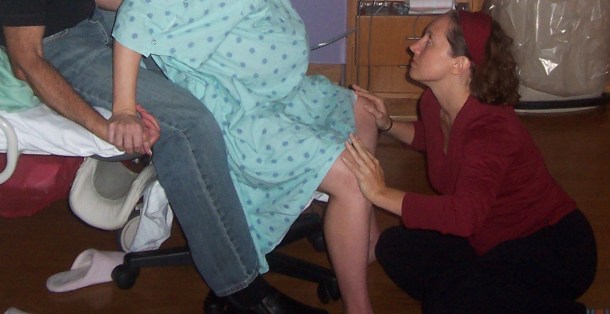
Do not stay in bed:  A great nurse will examine you or perform procedures in alternate positions.  However, if your nurse is not comfortable with this, use the bed for the duration of an exam/procedure only.  If you are being monitored, sit or stand by the bed, use the birth ball, or request a telemetry unit (if available).  Your partner or doula can volunteer to hold the monitor in place for wiggly babies.  In my experience, once you are in the bed, the monitors and blood pressure cuff stay on.  If you would like to lie down, consider using the couch!   

Stay unhooked:  Each time you are hooked up to a monitor, ask the nurse for a time frame.  She will likely leave.  If she has not returned by the time she gave you, unhook yourself. 

Control the mood:  Keep the lights low.  Keep the door closed.  Have music playing.  Massage mom with some lavender oil.  Use a low tone of voice.  If you create an atmosphere of serenity, your nurses and care providers will usually join in.  At a recent birth, the nurse commented on how much she loved coming into our room because it was so peaceful.  She automatically relaxed and lowered her voice.  If your nurse forgets to turn the lights down or shut the door when she leaves, the birth partner or doula should jump on it. 

No one should talk during pressure waves:  Maybe the hospital staff will join in the silent tribute if the birth partner and doula are quiet during mom’s pressure waves.  I’ve noticed that hospital staff can be quite chatty during labors.  Staying quiet during waves reminds everyone to keep their focus on the mom.  The birth partner may “shhh” someone if needed.

Memorize BRAIN:  What are the Benefits?  What are the Risks?  What are the Alternatives?  What does my Intuition tell me?  And what if we do Nothing?

Order a squat bar:  If your hospital has one (or more), request it.  Sometimes it takes a while to find it (and dust it off). 

Have a SHORT birth plan and/or baby care plan:  I think a birth plan can be a positive tool.  Include the names of everyone on the birth team and include the baby’s name.  Keep it short.  Do not include things that are easy to speak up for in the moment–like freedom of movement or minimal vaginal exams.  I recommend focusing on 2nd stage and 3rd stage birthing practices–birth position, routine 3rd stage pitocin, cord care, pushing, immediate skin-to-skin, etc.  These are the times that mom needs lots of support and focus.  Your nurse can help facilitate your birth plan at this point.  What is a baby care plan?  I’ve noticed that it is tough to communicate with the baby nurse in advance.  She often arrives as “delivery is imminent.”  She doesn’t know you.  Doesn’t know what you want.  You can create a simple baby plan and place it in the newborn warmer for her to find as she sets up.  Include the things that are important to you:  immediate skin-to-skin, procedures that should be delayed at least an hour, procedures you are declining, etc. 

When you feel “pushy,” wait:  This one might be controversial.  Things seem to get a little wild in the hospital when it is “time to push.”  If you’re laboring quietly and you feel some spontaneous pushing sensations, try to ignore them or bear down a little.  It is a great time to hang out in a dark bathroom with the door closed.  There is no need to rush the drama that will come.  Sometimes you begin feeling “pushy” before you are fully dilated and you’ll end up with several vaginal exams, instructions not to push, words tossed around like “anterior lip,” and “you’ll tear your cervix.”  You really don’t need multiple fingers messing with your sphincter when you’re trying to release a baby.  If you’re comfortable, lie low and wait until you have the absolutely-can’t-help-myself-hurling-pushing waves to call in the staff. 

Don’t give up the baby:  Finally, your little one is in your arms.  Barring medical concerns, keep the sweetling in arms.  If the well-meaning baby nurse says “let me just take him for…” understand that it could be 15-30 minutes before you get the babe back.  Delay, delay, delay.  Eye ointment, shots, footprints, tagging–these things can be delayed and they can also be done in mama’s arms.  Keep your newborn skin-to-skin as long as possible.  Just say “no” with a disarming smile, of course.
Purple

Posted on

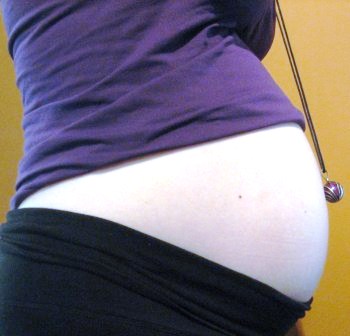
img_7974I’m feeling purple lately.  My purple day-lilies are blooming and grace the house with their showy petals. 

I’m wearing the purple bellychime Scott gave me.  I love the unobtrusive gentle chime it makes against my growing bump–ok, more than a bump.  Way more. 

And, one of my snazzy former clients gifted me with a violet doula shirt to get me through the summer.  My current one was looking a tad leotardish and would have surely ripped at the seams by June.  My new prana shirt is even made from post-consumer PET (that is plastic bottles–hoorah!). 

Speaking of doula gear.  I am particular about what I wear and carry to births.  My hubby–who is a complete outdoor gear freak–has taught me that gear can make or break an experience.  When I leave for a birth, I don’t know how long I’ll be gone, how long I’ll wear my clothes, what the temperature will be, if I’ll get wet, etc.  I wear prana clothes because they are durable, comfortable, flexible, and dry quickly.  Prana specializes in yoga and rock-climbing gear which seems perfect for the the contorted positions I end up in at births.  My socks are smartwools–again, they dry quickly.  My shoes are Mions.  Scott researched and selected the shoes–designed by one of the Keen founders.  I was skeptical (I thought they were ugly).  But, oh wow.  They are so comfortable and they have incredible techy features.  They repel water, the ergonomic footbed can be removed and washed, and they are mostly made from post-consumer materials in factories using wind and solar energy.  Oh, and they have wet/dry traction so I don’t bust it while I’m supporting a client.  Unfortunately, I don’t think the company is still alive; although the product is still be sold in limited supplies.  On a side note, weirdly, every female OB that I’ve worked with has asked about these shoes.  Every one.  Finally, my bag is the Osprey Elroy made almost entirely from recycled materials.  The fabric is 100% post-consumer PET (more plastic bottles).  Thanks Scott!

Enough digression about my doula-gear.  I’m feeling bluish-purple about my upcoming maternity leave from doula-ing.  I’m going to miss it.  And I hope I can find clients again after an absence.  Since I can’t exactly leave my laboring mamas to pump breastmilk, maternity leave will necessarily be long. 

I’m also completely booked for the remaining months before my birth.  I’ve had to turn a couple of families away which was tough for me to do.  But I know there are limits.       

My new big-belly accomodating doula shirt

My new big-belly accomodating doula shirt

So you want to be a doula

I frequently encounter women who say “I think I’d like to be a doula.”  I get that.  For those of us who love birth, what better profession to choose than midwife, l&d nurse, doula? 

It does sound like fun–emotionally and physically supporting couples during one of the most important moments of their lives; being invited to witness such a stunning event.  And it is.  I love being a doula.  It is the best job I’ve ever had.  But…let me also share the reality of the profession.  Just like any job, it has challenges.  And I don’t think I really thought about these challenges before jumping headlong.

Looking over my births this year, the average amount of time I spent with a client in labor was 12 hours.  So while that means I may have had one four hour labor, I also had a couple of 20+ hour labors.  And I have no way to predict how long I will be gone when I kiss my toddler good-bye.  And I bail on my friends all the time.  Choosing this profession means that I commit to my clients that I will be with them through their labor.  I look at it this way:  What would it feel like to a mom who has been laboring 15 hours for her doula to leave?  To call in a replacement?   

I’m on call.  Enough said.  Ask my husband how he feels about that one.

I have a list a mile long of friends and family who can care for Norah.  I regularly interrupt their lives with sentences like this “Hi friend.  So I have this client who might be in labor.  If she calls me before 6am, Scott will take Norah to person A.  But if she calls after 6am, can I bring her to you?  Oh, and I don’t know who will pick her up or when.” 

My job is to support women who are feeling discomfort.  For hours.  At 4am, when I’ve been there for 10 hours already, I do sometimes question why I’m doing this. 

Doulas must be physically lithe.  Seriously.  I contort into bizarre positions to apply counter pressure to a woman laboring in a tub.  I crawl around on the floor, hold women carrying an extra 30lbs in a supported squat, climb on top of hospital beds, and let my hand be squeezed…really hard!  

alicia-009
Somewhere around hour 13. I kept sliding backward as I applied counterpressure.

We need to have strong stomachs and gracious hearts.  I’ve been kicked in the face, covered with amniotic fluid, and I’ve cleaned up lots of poop and vomit.  While I’ve not yet been cursed at, I have had a birth ball thrown in my general direction.

Sometimes (though not too often), the rest of the birth team doesn’t want you there.  Sometimes nurses don’t like you.  Or sometimes, the client’s family resents that you get to be at the birth instead of them.

Doulas must hang in there emotionally.  It is hard to not get distracted by discouragement, hunger, the need to pee, conversations between nurses or midwives, a husband asking when are you coming home, or just fatigue.  Our intuition is key and for that we must stay alert and in the moment.

Finally, after the joy of birth (which of course makes all the work worth it!), it is hard to leave.  After the postpartum care is over, it is difficult to suddenly not see this family you’ve worked so closely with over the last weeks or months.

I’ve worked in non-profit, corporate, education, and ministry.  Doula work is by far the most difficult.  And the most rewarding.  I take my definition of doula as Jesus and early Christians used the word:  slave.  The One I most want to emulate was described as emptying himself and taking on the form of a doulos–the male form of doula (Philippians 2:7).  What better role model?

Pregnancy, Power, and Parenting

I spoke yesterday at an Attachment Parenting Forum.  The topic was how choices in childbirth were related to the first AP Principle:  preparing for pregnancy, birth, and parenting.  I joined a forum with a midwife and two childbirth educators

In my classic style, I did not prepare at all.  I had no idea what I was going to say.  So I was pleasantly surprised when coherent words came out of my mouth.  And I was even happier that when I finished speaking, I agreed with what I had said.  Sounds schizophrenic, yes?  Welcome to my public speaking technique.    

I said that one of my primary roles as a doula is to guard power.  I don’t care what kind of birth my clients choose or end up having; my concern is that they retain their power throughout.  They are not bullied or undermined.  They have informed consent.  They understand and claim responsibility for their birth.  The power of pregnancy and birth springboard us into confident parenting.  When our friends and family question our AP methods or on a sleepless night 5 months postpartum, we question ourselves, we can draw on the strength and trust learned through birth. 

Parenting is not rocket science.  It is much harder.  It calls for something more than mere instruction manuals.  It demands an inner strength beyond anything else.  Those 9 months of pregnancy and however many hours of labor and birth can lay a firm foundation for our parenting; particularly when our choices are questioned at every turn.

A doula’s challenge

Each week, I send an email to my pregnant clients.  These emails are usually for their eyes only but I thought I would share a recent one.  Note:  most of my clients (lately) are hospital births so we typically spend much of the labor in their homes.   

Restraint.  When folks ask me what is the hardest part of being a doula, I answer “restraint.”  We doulas get riled up about doctors and midwives who use unnecessary interventions.  “Humph,” we complain.  Why can’t they simply trust birth? 
 
But we are often guilty of the same thing.  When I first began as a doula, I thought I was supposed to whip out all my tricks and tools.  I figured these families were paying me to do something.  My thoughts went something like this:  “Ok, I need to do x to keep her labor from stalling.  I should do y to make sure the baby descends.  I must do z to encourage her to release more oxytocin.”  You realize what I was doing?  Using unnecessary interventions.  Maybe they were harmless and maybe they even helped but they may not have been necessary.  And sometimes, they took away power from the birthing woman. 
 
Why couldn’t I simply trust birth? 
 
Do you remember those early studies on doulas–you know, the ones that showed incredible reductions in c-sections and other interventions and incredible increases in mother satisfaction?  Most often, the mom didn’t even know she had a doula.  The doula was simply present as part of the medical team–it was a blind study.  Her mere continued presence resulted in positive outcomes.  How could that be? 
 
It is a tricky profession.  In the aftermath of a normal birth, it should feel like the doula or the midwife/doctor didn’t do anything.  Our goal should be to fade into the background of the story.   
 
Now don’t worry–this rambling doesn’t mean that I’m not going to give you nice foot massages or help you relax during your labor.  It does not mean that if I suspect any roadblocks (positioning, difficulty focusing, etc), I won’t pull out a trick or two.  But if your labor is progressing normally, sometimes the best tool I have is simply to be there.  To be a gatekeeper or lifeguard; not a director.  And yes, I struggle with this.  I want to jump in and save the day. 
 
Ah, but you don’t need to be saved.  This journey is yours and you are the hero in this adventure. 
 
Homework:  Trust is an essential element in normal birth.  Do you trust your body?  For some women, pregnancy may offer the first challenge of this sort; the first opportunity you’ve had to be awe-struck by your amazing body at work.  Practice trust and intuition by asking and listening during pregnancy.  For example, thoughtfully ask yourself questions like “how does my body want to stretch?” “should I rest now?” “what would nourish me today?”  
 
This quote was written to midwives but I think it applies to all those who are invited into the presence of birth: 
Do good without show or fuss. 
Facilitate what is happening rather than what you think ought to be happening. 
If you must lead, lead so the woman is helped yet still free and in charge.  
When the baby is born, the woman will rightly say, “We did it ourselves.” 
–from the Tao Te Ching

“Soon They’ll Be Asking for Informed Consent”

I caught that line from an overheard snippet of House M.D. recently.  Someone told House to get consent before a procedure.  He sarcastically replied something to the effect:  Start getting consent for procedures and soon they’ll be asking for informed consent.

Well there is a new tool in the informed consent workshop.  Released this week, the Milbank Report:  Evidence-Based Maternity Care Report has the US abuzz.  Consumer Reports even released a report on the findings.  One of the quotes I love in the Milbank report’s executive survey is “The many beneficial, underused practices around the time of birth include continuous labor support, numerous measures that increase comfort and facilitate labor progress, nonsupine positions for giving birth, delayed cord clamping, and early mother-baby skin-to-skin contact.”  Humph.  Nonsupine positions, delayed cord clamping, and immediate skin-to-skin are usually the most difficult concessions to get in hospital births I attend.  There is always some reason why it can’t be done. 

The sum-up of the findings seems to be hire a family practice physician or midwife to attend your birth, hire a doula, and know which processes are evidence-based.  Not sure how to discern evidence-based practices?  I usually go first to the Cochrane Database of Systematic Reviews.

Chewing on a Piece of Grass

I realized something recently.  I always listen to Ventura Highway on my way to a birth or prenatal/postpartum appointment.  What is that all about?  The song relaxes me so maybe it is my subconscious attempt to encourage oxytocin–the love hormone?  Or maybe I’m self-medicating?  My sister (the counselor) teased me recently by “diagnosing” me with a social phobia.  Synthetic oxytocin is currently being studied as a treatment for social phobia.  Still, who needs oxytocin nasal spray when you can listen to America?

At least I think she was teasing me…

Till Human Voices Wake Us, Or Why I Wish Doulas didn’t Exist

Posted on

I imagine if you visited a culture in which birth was considered a normal event–a visible part of the community–the idea of hiring a doula would be laughable.  Your intuitive knowledge of birth would be intact.  You would believe that since you figured out how to digest your food and how to wake up after sleeping, you would, indeed, know how to birth.  And the people around you would let you.

In our culture, birth is private.  Typically we retreat into the den of medicine, technology, and malpractice to celebrate our journey into motherhood.  Once entangled in this trinity, we are pinned and wriggling on the wall so how should we presume?

And we need instruction and authority and equipment to deliver. 

Some families hire a doula.  A woman who has attended many types of births.  A woman who can navigate the intricacies of the system.  I do believe that whether planning a medicated birth, a cesarean, or a low intervention experience, families can enjoy the best outcomes with a doula at their side.  The doula becomes the surrogate community that is missing in our culture–she provides support from early pregnancy coffee shop talks to postpartum home visits.  And she is the advocate–working for the family and no one else; no hidden agendas, no judgement, and no insurance company to answer to.  And–she is pretty inexpensive considering she is on call 24/7 for you.  She’s less expensive than an epidural and probably less expensive than the bill from your wedding florist.  

The fact that the profession of doula exists is merely one symptom of a deep isolation, fear, mystery, and sterility surrounding birth.  So while I love being a doula, I’m sad that the profession is necessary.  I wish that our community guarded the sacred transformative power of birth instead of timing it, numbing it, sterilizing it, insuring it, managing it.

Midnight Arrival

Posted on

Long Drive.

Strong Mama.

Great Music.

15 Minutes of Pushing.

Healthy Baby.

Immediate Breastfeeding.

Long Drive.

Tired Happy Doula.