Jenny blogs at Babyfingers about mothering, birth, and more. These are her thoughts about her recent homebirth.
Homebirth and Courage: You don’t have to be a hero
I’d intended to write one post comparing my two births, but then realized it would be a book, not a post. Therefore, I am breaking it up. Right now I’d like to write about courage and how it played into both of my births.
During my pregnancy with Ivey, upon revealing to others my desire for a homebirth, I was told no less than 20 times how brave I was. This is commonly said to women who birth at home, so I wasn’t surprised. (In some cases it is probably a polite way of saying have you lost your MIND?!) But taking it at face value, it didn’t fit. I wasn’t trying to be a hero; I was just doing what was best for our family and, actually, what was easiest for us. After the birth, people were more thoroughly convinced of my bravery. In particular, people who had experienced or witnessed childbirth with pain meds were impressed that I’d endured without them. Their comments were confusing for me, though, considering what an easy time I’d had compared to my hospital birth! I thought back to Suzi’s birth and realized that although it was ten times as painful and traumatic as Ivey’s, no one had told me I was brave. In fact, I felt a little like a failure after Suzi’s hospital birth. That birth required so much more courage than Ivey’s homebirth did, and courage of a different sort.
For Ivey’s birth I had a tough decision to make. Would I go with the same type of OB care that I’d had with Suzi, or would I go with a midwife and hope for something better? After what happened with Suzi’s birth I realized that, unfortunately, a woman has to study like she’s pursuing a college degree to truly optimize her birth experience. Nagging questions regarding Suzi’s birth swirled in my head. Were the things that had gone wrong my own fault, or due to some deficiency of my body? Were some things poorly handled by my doctor and nurses? I talked things over with knowledgeable friends, read books, watched films, and found blogs and articles online. I did most of this before Ivey was even a twinkle in Jordan’s eye, so by the time we realized we were pregnant we were already 99% sure we were going with a midwife. It took courage to make a break from conventional prenatal care, even though I knew in my heart that a midwife was best for me and the baby. One day when I was about six weeks pregnant, my morning sickness suddenly came to a halt and I began to wonder if it might be a sign of a miscarriage. I panicked, and we went the only place we could think of–back to our old OB’s office to beg for an early ultrasound. Ivey was fine, of course; we saw a healthy flicker of a heartbeat and were so grateful for the doctor’s help. I had mentioned my desire for a homebirth, though, so after the ultrasound we sat through a lecture in his office. He told us of a homebirth-turned-hospital-transfer he’d seen recently, during which the mother came in screaming for drugs and ended up with a c-section after what he said would have been a shoulder dystocia. The mom and baby were both fine, but he insisted things could’ve easily ended differently. The words dead baby were uttered–something you should never say to a pregnant woman. We prayed about it and I realized that my previous hospital birth was definitely not what God had intended. I knew that anyone who would use scare tactics to change my mind must be pathetically lost from what is right, and that since I knew God wanted me to have a homebirth, I should trust Him to keep me and my baby safe.
The concept of homebirth was a stretch for both my family and Jordan’s. Although we were both born naturally (meaning without pain meds), we were both born in a hospital. Jordan’s mother is a nurse and my mother is a natural-born worrier. While his mother (and grandmother, and father, etc) kept bringing up how Jordan had been born with the cord around his neck, my mother busied herself asking questions of the what-if variety. She came to the initial meeting with our midwives and got a long list of questions out of the way there. Afterwards, she was mostly satisfied with our midwives’ competency and supportive of our plans to have a homebirth. Various other family members, acquaintances and strangers, however, continued to pester us with negative comments and questions they didn’t truly want answered. It was exhausting and unproductive for us to deal with them. It takes courage to stand up to friends and family and to accept unfounded criticism.
Then our insurance refused to cover the homebirth, and that was hurtful in several ways. We knew that if we ended up transporting to the hospital during labor, we’d be responsible for the entire out-of-pocket cost of a homebirth as well as the portion of our hospital bill that our insurance didn’t cover. It stung to learn that our insurance company (we are on the SC State Plan) could do something as unfair as refusing to cover a perfectly valid and safe birth choice, but they can. We decided to have our homebirth anyway.
In my own mind, such a drastic change required me to accept that something was wrong with Suzi’s birth. It wasn’t easy to accept that my baby’s birth could have been better, but the more research I did the more obvious it became that this was true. This is something many women must accept, and I believe it is the main reason women are always telling birth “horror stories.” My midwife pointed out recently that we seek out a birth experience which will confirm what we already believe about ourselves. As an extension of that, I think some women tell their birth stories hoping to confirm things about themselves. Some women want reassurance that their birth was going to be the way it was no matter what; that there was no way, for instance, to avoid an induction which led to a c-section. In my case, I told my story looking for reassurance that I could have had a better birth if it had been managed better. I wanted to believe I had made poor decisions, not done enough research, or maybe even been a victim if it meant I could have a second chance at birthing naturally. I’ve read the stories of (or have met) some other women who have planned homebirths after bad hospital experiences, and this seems to be a fairly common sentiment.
With Suzi, I wanted a natural childbirth and I did try for one, but I was too naive to realize what I needed to do for this to happen. I planned a hospital birth with an OB who was skeptical, at best, of my ability to birth naturally. Despite our perfect attendance in childbirth class (it was the hospital-sponsored one) and all my reading (I must’ve read the wrong books) things did not go the way I’d envisioned. If you’d like to read the whole story, it’s here.
It takes a lot of courage to walk into a hospital knowing that you and your “progress” are about to be judged. To wonder which doctor you might get. To be hooked up to machines and confined to bed. To lose the ability to labor in exactly the way you wanted. The hospital can be utterly distracting for a laboring woman during a time when she needs to concentrate like she’s never concentrated before. It takes a lot of courage to (in a single evening) allow the fingers of five different strangers, some male and some female, to be inserted into your vagina. When and if a woman reaches the pushing stage, it takes courage to have her vagina put on display under a spotlight as though it’s about to perform in a Broadway musical. Women are expected to quietly accept these unacceptable conditions of a hospital birth.
There were at least ten people in my L&D room during the pushing stage. I pushed for over two hours so some people left and others came in. Once I received the “okay” to push (I had an epidural so I had no opinion on when would be best to start) a nurse said, “just a minute–we’ve got to get a few things set up.” It took two or three people to assemble the staggering collection of ominous metal objects that were evidently necessary for my birth. They laid them all out on a table at my feet, and then removed the bottom half of my hospital bed and brought down the lamp, which seemed brighter than the high-beams on my minivan. My doctor decided to try for a vacuum delivery after I’d been pushing a long time, which involves using a plunger-like device to reach into the vagina and pull the baby out by the top of her head. I wondered what it could possibly do to my baby’s head and neck. It takes courage for a woman to trust strangers to get her baby out safely, particularly when it seems everything is a big emergency.
So far I’ve mentioned parts of my own birth, which are common to many women. But what about women who have c-sections? First there are scheduled c-sections for which a woman must sit and wait, knowing what is about to happen to her. Then there are emergency c-sections, which not only require a woman to be cut open while awake, but also to suddenly face that the birth she hoped for is not going to happen, which can be devastating. In either case, most women lie behind the blue curtain acutely aware of the major surgery that is happening on the other side. After the ordeal is over, most of them do not even get to hold their babies right away. In some cases women are put under general anesthesia and this is probably even worse. This happened to one of my friends and a couple of hours passed after the birth before she even got to see her baby. There are so many other women who go through terrifying births–mothers of preemies, women with high-risk pregnancies, and women who were previously sexually abused, to name a few.
And I am brave for having a homebirth? Once we’d made the decision to have our homebirth, actually having the baby took very little courage because I wasn’t afraid. I loved knowing that Carey, not only my midwife but my friend, would be coming to help us and not just whoever was on call. She acted as though everything was as normal as it could be as she set up her supplies with a sense of urgency, but not emergency. Instead of making me constantly wear two restrictive monitor belts on my belly, she checked Ivey’s heartbeat intermittently with a handheld doppler, and I didn’t even have to get out of the tub for that. Both our midwives waited quietly during my pushing stage, and if anything had to be said they whispered it out of respect for my zone of concentration. In the comfort and familiarity of my home, my labor seemed to fly by. It never really registered as painful, because I didn’t fear what was happening. My husband was much more helpful at the homebirth because he didn’t feel brushed aside by doctors and nurses and wasn’t scared for me and the baby like he was in the hospital. When we discussed how things had gone, he told me he was glad we had not gone to the hospital because everything was made to seem like an emergency there. My favorite part of the homebirth was how we were allowed all the bonding time we wanted with our baby. All the tests and measuring were done in our presence, and were put off until we’d had time to welcome our daughter. We never had to worry where she’d been taken or what was being done to her. It felt so safe and perfect.
It’s just a myth that to consider having a homebirth a woman has to be brave, and I wish more women knew this. I frequently don’t feel brave at all (you should see me at the dentist) yet I had an amazingly successful homebirth. I feel that God gave me the birth experience I had so that I can tell others about it. Now that I’ve experienced birth both ways, if I ever have to go back to the hospital, that will require courage.
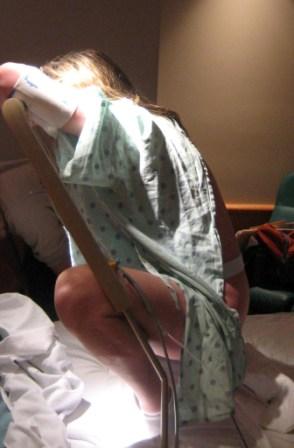 Some of the reasons vertical birth can be more beneficial than sitting or reclining:
 That is what I paid for my favorite wrap. I love when people stop me at the store to ask where I got “that.” And I say, “Well, it is just a long piece of cloth!”
  My first negative babywearing comment this time around:
 Inexplicable Ways